
Generative Engine Optimization (GEO) is the practice of structuring and enriching web content so that AI answer engines such as ChatGPT, Google AI Overviews, Perplexity, Gemini and Claude cite it inside the answers they generate. SEO aims to win a click from a list of links. GEO aims to win a mention inside the answer itself.
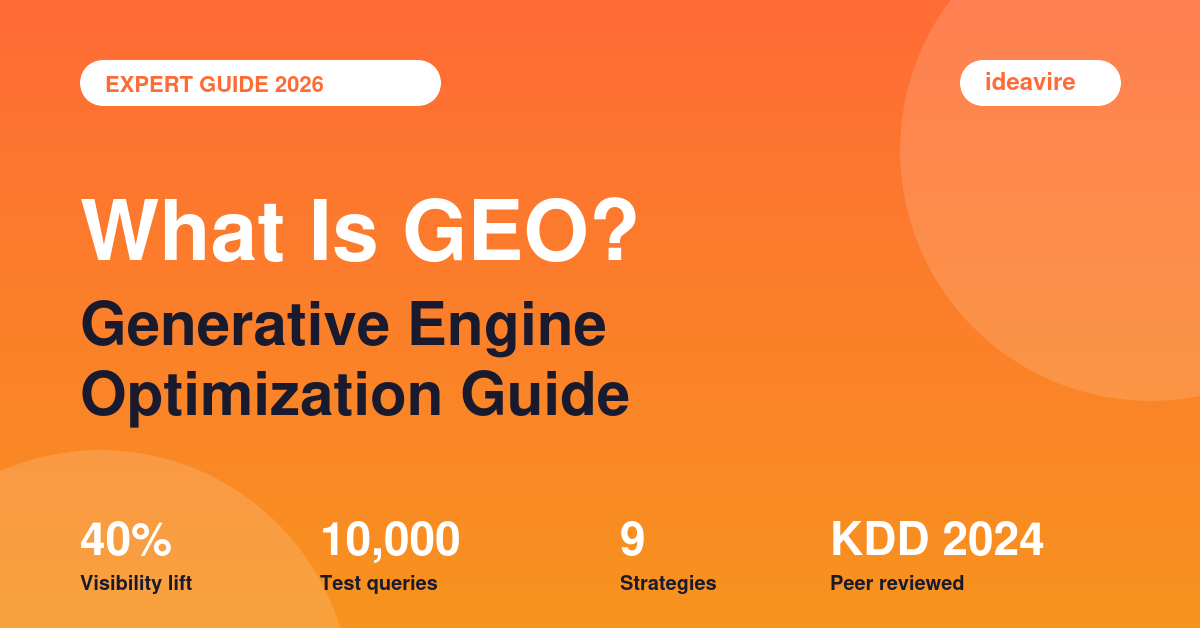
The term was introduced in a 2024 research paper from Princeton, Georgia Tech, the Allen Institute for AI and IIT Delhi, which found that content changes can lift visibility in generative engine responses by up to 40%. IdeaVire helps businesses worldwide combine classic SEO with GEO so they are found on Google and inside AI answers.
Table of Contents
ToggleKey Facts About GEO
- GEO targets citations inside AI answers, not only blue link rankings.
- The term comes from a paper presented at ACM SIGKDD 2024 in Barcelona (arXiv).
- The study tested nine optimization methods on GEO-bench, a set of 10,000 queries.
- Adding statistics, quotations and cited sources improved visibility by roughly 30 to 40% relative to the baseline (Search Engine Journal).
- Keyword stuffing produced little to no improvement in generative engine responses.
- Most AI answer engines retrieve sources from a search index first, so SEO and GEO work together.
- Citations shift week to week, so GEO is an ongoing process and not a one-time project.
What Is Generative Engine Optimization (GEO)?
A generative engine takes a question, gathers a set of web sources and uses a language model to write a single natural language answer with citations. Your goal in GEO is to be one of the sources it gathers and quotes. Researchers formalized this idea in the paper GEO: Generative Engine Optimization, which built a benchmark called GEO-bench from 10,000 real world style queries and measured how different content edits changed a page visibility in the final answer.
For a business, this means your marketing now has two audiences: people who click results, and AI systems that summarize them. IdeaVire covers both through its GEO and SEO services.
Why Does GEO Matter in 2026?
Three forces make GEO a priority this year:
- Answers are replacing lists. Google explains in its documentation on AI features and your website that AI Overviews and AI Mode show synthesized answers with links to supporting pages. Being one of those supporting pages is now part of search visibility.
- Smaller sites can win. The study reported that websites ranked fifth in search results saw a 115.1% visibility increase when they added cited sources, while top ranked sites lost visibility on average. GEO can help a challenger brand compete with bigger domains.
- Every engine has its own crawler. OpenAI and Perplexity publish documentation for their bots (OpenAI, Perplexity). If your site blocks them, you cannot be cited.
How Is GEO Different From SEO?
| Factor | Traditional SEO | GEO |
|---|---|---|
| Main goal | Rank pages and earn clicks | Be cited inside AI generated answers |
| Where results appear | Search result pages | ChatGPT, Perplexity, Gemini, AI Overviews, Copilot |
| What wins | Relevance, links, technical health | Direct answers, evidence, clarity, brand trust |
| Keyword stuffing | Discouraged | Little to no benefit in research tests |
| Measurement | Rankings, clicks, impressions | Citation rate per prompt and per engine |
| Stability | Changes over weeks and months | Can change week to week |
How Do You Do GEO? The IdeaVire GEO Framework
The IdeaVire GEO Framework is an 8 step process we use to make a website easier for AI engines to find, understand and cite.
Query Mapping
List the 20 to 40 questions your buyers ask AI tools, such as who is the best provider, how much does it cost and how do I choose. These prompts are your target keywords for GEO.
Answer-First Rewrite
Open every page and section with a direct 2 to 3 sentence answer. AI engines extract the passages that answer the question fastest.
Evidence Injection
Add specific statistics, short expert quotations and named sources to each section. These were the three strongest methods in the Princeton study.
Entity Clarity
Use one consistent brand name, description and set of facts across your site, About page and Organization schema so AI systems recognize who you are.
Structured Formatting
Use question-style headings, comparison tables, numbered steps and FAQ sections. Structured content is easier for AI systems to parse and quote.
Technical Access
Check robots.txt and firewall rules so search and AI crawlers such as Googlebot, Bingbot, OAI-SearchBot and PerplexityBot can read your pages.
Off-Site Corroboration
Earn mentions on directories, review sites, industry publications and communities. AI engines trust brands that are confirmed by third parties.
Measure and Refresh
Test your target prompts every month, record whether you are cited, and update pages that lose visibility.
Want Your Brand Cited by AI Search?
Get a free consultation on combining SEO and GEO for your website, with a clear plan and no obligation.
Which GEO Tactics Actually Work?
The research gives a useful ranking of what moves the needle. According to Search Engine Journal, the three strongest methods in the study were:
- Statistics addition. Replace vague claims with specific numbers and name where they come from.
- Quotation addition. Include short, attributed quotes from credible people or documents.
- Cite sources. Link to authoritative references that support each key claim.
These methods delivered relative improvements of about 30 to 40% over the baseline. Fluency optimization and easy to understand writing also helped, with gains in the 15 to 30% range. When the researchers tested Perplexity, a real world engine, visibility improved by up to 37% on one of the metrics. Results varied by topic, so test on your own subject area.
What does not work
Keyword stuffing, the old SEO shortcut, gave little to no improvement in generative engine responses. Write for clarity and proof, not for repetition.
What Are the Most Common GEO Mistakes?
- Treating GEO as keyword stuffing with a new name.
- Publishing claims without numbers or named sources.
- Accidentally blocking AI crawlers in robots.txt or a firewall.
- Burying the answer under a long introduction.
- Using inconsistent brand facts across the website and profiles.
- Ignoring off-site mentions, reviews and directory listings.
- Measuring only Google rankings and never checking AI answers.
- Optimizing once and never refreshing the content.
How Do You Measure GEO Results?
GEO does not show up neatly in a rank tracker, so build a simple monthly routine:
- Citation rate: run your 20 to 40 target prompts in each engine and record how often your brand or pages are cited.
- Share of voice: compare your citations with those of your top three competitors.
- AI referral traffic: check analytics for visits from sources such as chatgpt.com and perplexity.ai.
- Branded search growth: track whether more people search for your brand name over time.
Frequently Asked Questions About GEO
What is generative engine optimization in simple terms?
Is GEO the same as SEO?
Is GEO the same as AEO?
Does GEO replace SEO?
How long does GEO take to work?
Which AI engines should I optimize for?
Does schema markup help GEO?
Can anyone guarantee that ChatGPT will cite my website?
What kind of content gets cited most?
Who needs GEO the most?
About IdeaVire
IdeaVire is a global IT services company that provides web design and development, mobile app development, UI/UX design, SEO, GEO and AI integrations for startups, small businesses and enterprises. To go deeper, read our guides to generative engine optimization services and SEO services for small business, or book a call to discuss your project.
